
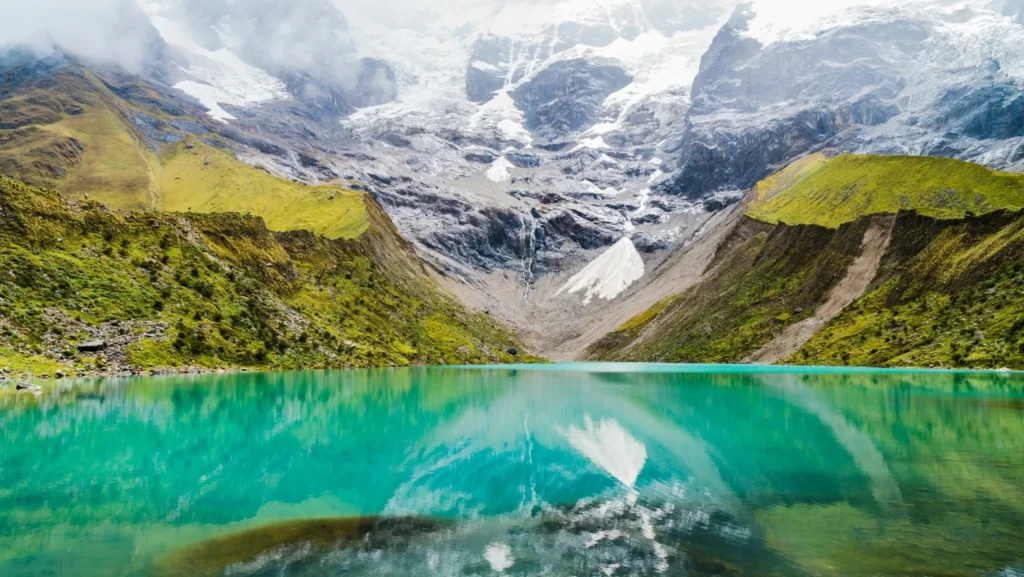
The journey to Humantay Lake unfolds within one of the most visually dramatic sectors of the Peruvian Andes. Located beneath the glaciated slopes of Mount Salkantay, the lake sits at over 4,200 metres above sea level, forming part of a fragile ecosystem shaped by meltwater, mineral composition, and seasonal variation.
Undertaking a humantay lake tour from cusco involves more than a simple excursion. It is a transition from the urban fabric of Cusco into a high-altitude environment where geography becomes the dominant force. The route traverses valleys once used for agriculture and herding, before ascending into terrain where vegetation thins and the horizon is defined by snow and stone.
The Geography and Formation of Humantay Lake
Humantay Lake owes its distinctive turquoise colour to glacial minerals suspended in its waters. These fine particles reflect sunlight in a way that produces a saturated, almost opaque hue—one that changes subtly depending on weather conditions and time of day.
The lake is fed by the glaciers of Mount Humantay, a satellite peak of Salkantay, which rises to over 6,200 metres. In Andean cosmology, Salkantay is considered an apu, or mountain spirit, associated with protection and natural power.
This context shapes not only the landscape but also the cultural significance of the area. Offerings are still made by local communities, particularly during agricultural cycles, reinforcing the connection between environment and belief.
The Route for a humantay lake tour from cusco
Departure from Cusco
Most itineraries begin in the early hours, with departure from Cusco before sunrise. The route follows a north-western trajectory toward the village of Mollepata, passing through agricultural zones characterised by maize fields and terraced slopes.
The drive itself provides an initial layer of context, revealing how the Andes are still actively cultivated despite their altitude and terrain.
Mollepata to Soraypampa
From Mollepata, the journey continues by vehicle to Soraypampa, a remote settlement situated at approximately 3,900 metres. This location serves as the starting point for the ascent to Humantay Lake.
Soraypampa is also a key waypoint for those undertaking the Salkantay Trek. Its open landscape, surrounded by towering peaks, offers a clear indication of the scale that defines this region.
The Ascent to the Lake
The final approach to Humantay Lake is completed on foot. The trail ascends steadily over a distance of roughly 1.5 to 2 kilometres, with an elevation gain of around 300 metres.
This section requires physical effort, particularly due to altitude. The terrain is uneven, and the air noticeably thinner. However, the path is well-defined, and alternative options—such as horseback support—are often available for those requiring assistance.
Upon reaching the summit, the lake appears abruptly, framed by steep slopes and the glacial face above. The visual contrast between the water and surrounding rock creates a stark, almost abstract composition.
Luxury and Private Approaches
While many travellers undertake this excursion in group formats, a humantay lake tour from cusco can be structured as a private experience, significantly altering its pace and quality.
Private Transport and Timing
Departing later than standard group tours allows for a quieter ascent, avoiding peak arrival times at the lake. Private vehicles also enable flexible stops along the route, whether for photography, rest, or engagement with local communities.
Guided Interpretation
A knowledgeable guide provides context beyond the visual. This includes:
- Geological explanations of glacial formation
- Cultural insights into Andean cosmology
- Observations on local agricultural practices
Such interpretation transforms the excursion from a physical challenge into an intellectual and cultural experience.
Curated Dining
Private tours often incorporate carefully planned meals, replacing standard roadside stops with tailored options. Breakfasts in Mollepata and lunches upon return can be arranged in more considered settings, emphasising regional ingredients and presentation.
Altitude, Climate, and Physical Preparation
Acclimatisation
Given the elevation of Humantay Lake, prior acclimatisation in Cusco or the Sacred Valley is essential. Travellers arriving directly from sea level may experience symptoms of altitude sickness, including fatigue, headaches, and shortness of breath.
Spending at least 48 hours at altitude before undertaking the tour is strongly advised.
Weather Conditions
The climate is variable and can shift rapidly:
- Mornings tend to be clear, with strong sunlight
- Afternoons may bring cloud cover or sudden rain
- Temperatures fluctuate significantly between day and night
Layered clothing, sun protection, and adequate hydration are necessary.
Cultural Context and Local Communities
The route to Humantay Lake passes through areas inhabited by Quechua-speaking communities whose livelihoods remain closely tied to agriculture and livestock.
Traditional clothing, often worn daily rather than for display, reflects both practicality and identity. Textiles are produced using techniques passed down through generations, incorporating natural dyes and symbolic patterns.
Respectful interaction is essential. Photography should be approached with sensitivity, and engagement should prioritise observation over intrusion.
Environmental Considerations
Humantay Lake exists within a delicate ecosystem. Increased visitor numbers have introduced challenges related to waste management and trail erosion.
Responsible travel practices include:
- Carrying out all waste
- Staying on designated paths
- Avoiding disturbance to local flora and fauna
Private tours often place greater emphasis on these principles, ensuring that the impact of visitation is minimised.
Seasonal Variation
Dry Season (May to September)
- Clear visibility of surrounding peaks
- More stable trail conditions
- Cooler temperatures, particularly in early morning
Wet Season (November to March)
- Increased vegetation and more intense colour contrasts
- Higher of rain and cloud cover
- Fewer visitors, resulting in a quieter experience
Each season offers a distinct interpretation of the landscape, altering both its appearance and accessibility.
The Experience Beyond the Destination
A humantay lake tour from cusco is often approached as a single-day excursion, yet its significance extends beyond the lake itself.
The gradual transition—from urban Cusco to rural valleys, and finally to high-altitude terrain—mirrors broader patterns within the Andes. It reflects how geography dictates movement, settlement, and culture.
Unlike Machu Picchu, which is defined by human construction, Humantay Lake is shaped entirely by natural processes. Its appeal lies not in architecture, but in the interplay of water, light, and elevation.
The stillness of the lake, interrupted only by wind or shifting clouds, creates a setting where scale becomes difficult to measure. Mountains dominate the horizon, yet the lake itself remains contained—an enclosed system within a vast landscape.
A Measured Encounter with the Andes
Undertaking a humantay lake tour from cusco requires both physical readiness and an openness to the conditions imposed by altitude and climate. It is not a passive experience, but one that demands participation.
In return, it offers a perspective rarely encountered in more accessible destinations: a landscape defined by geological forces, cultural continuity, and environmental sensitivity.
The journey does not conclude at the lake’s edge. It continues in the descent, in the return to lower altitudes, and in the gradual re-entry into the rhythms of Cusco—carrying with it a clearer understanding of the terrain that surrounds it.